How to Crate Train a Cat: A Step-by-Step Behavioral Guide

How to Crate Train a Cat: A Step-by-Step Behavioral Guide

How to Crate Train a Cat: A Step-by-Step Behavioral Guide

Quick Summary: Successful cat crate training hinges on transforming the carrier into a predictable, rewarding sanctuary rather than a harbinger of stress. By encouraging voluntary entry, practicing gradual door closure, and introducing motion systematically, you can ensure your cat remains calm during vet visits, travel, or necessary short-term confinement. The golden rule is simple: make the crate a normal part of your cat's daily environment long before you actually need to use it.


Why Crate Training Matters for Feline Well-Being

Most cat owners only bring out the carrier when a stressful event is imminent, such as a veterinary checkup or a long road trip. Because cats learn rapidly via negative association, the sudden appearance of the crate triggers an immediate fight-or-flight response. proactive crate training fundamentally alters this dynamic, providing massive benefits:

  • Reduced Transport Anxiety: A trained cat treats the carrier as a safe mobile bedroom, drastically lowering their cortisol levels during car rides.
  • Emergency Preparedness: In the event of a natural disaster, fire, or sudden evacuation, a cat that willingly enters their crate can save critical, life-saving minutes.
  • Frictionless Veterinary Care: Medical professionals can evaluate a calm cat much more thoroughly and safely than a panicked, defensive animal.
  • Behavioral Reset: For felines recovering from surgery or undergoing a structured behavioral reset (such as managing sudden litter box issues), a crate serves as a controlled, low-stimulus environment.

Choosing the Ideal Crate Architecture

Before beginning the training process, ensure you have the right equipment. The carrier must accommodate your cat’s specific physical and behavioral needs.

Size and Stability

The crate must be large enough for your cat to comfortably stand up, turn around completely, and lie down in a natural Sphinx or sleeping position. However, avoid excessively large crates for travel, as they lack stability and can cause the cat to slide around precariously during transport.

Accessibility and Material

Two-door carriers—specifically those featuring both a front-loading door and a top-loading hatch—are highly recommended by feline behaviorists. Top-loading options allow you to gently lower a nervous cat into the carrier or allow a vet to examine the cat while it remains safely nestled in the bottom half. If your cat is prone to stress-induced elimination or spraying, opt for a rigid, non-porous plastic crate that is entirely washable, and line it with highly absorbent, easily exchangeable training pads rather than plush, hard-to-wash beds.


The 5-Step Crate Training Roadmap

Feline behavioral modification requires a systematic approach. Progress through these steps sequentially, only moving forward when your cat remains completely relaxed at the current stage.

Step 1: Environmental Neutralization (Making the Crate Normal)

Place the crate in a high-traffic, low-stress area of your home, such as the living room or your cat’s favorite sleeping corner. Secure the door completely open so it cannot accidentally swing shut and startle them. Place a familiar, scent-soaked blanket inside. Let the crate sit as a permanent piece of household furniture for several days, allowing your cat to investigate it purely on their own terms without human intervention.

Step 2: Dietary Counter-Conditioning

Leverage the power of food to rewrite your cat's emotional response to the carrier:

  1. Day 1–3: Place your cat’s food bowl a few feet away from the open crate.
  2. Day 4–7: Move the bowl directly outside the crate's threshold.
  3. Day 8 and beyond: Move the bowl entirely inside the back of the crate.

If your cat hesitates, step out of the room to remove any perceived social pressure. Soon, they will associate the physical structure of the crate with high-value rewards.

Step 3: Implementing Vocal and Action Cues

Once your cat comfortably walks into the carrier to eat, introduce a specific verbal cue (e.g., "In" or "Crate"). Toss a high-value treat (like freeze-dried chicken or a lickable treat) into the back of the carrier, utter the cue word, and praise them warmly the moment they step inside. This transitions the behavior from a passive exploration to an intentional, active choice.

Step 4: Systematic Desensitization to Door Closure

While your cat is happily eating a treat inside the carrier, gently swing the door shut for exactly two seconds, then immediately reopen it and offer another treat. Do not latch it tightly or lock them in initially. Gradually scale up the duration of the closure:

  • Session 1: Closed for 2 seconds → Open → Reward.
  • Session 2: Closed for 10 seconds → Open → Reward.
  • Session 3: Closed for 1 minute while you sit quietly right outside the mesh.

Crucial Rule: If your cat begins to meow, scratch, or show signs of distress, you have moved too fast. Wait for a brief moment of calm, open the door, and regress to the previous step in your next training session.

Step 5: Introducing Micro-Movements

Once your cat accepts a closed door for a few minutes, close and latch the door securely. Gently lift the carrier a mere two inches off the ground using smooth, non-jerky movements. Hold it steady for a moment, place it down, open the door, and reward them. Slowly expand this into short walks across the living room, down the hallway, and eventually out to a stationary car.

Advanced Management: Cleanliness & Confinement Realities

The Impact of Olfactory Traces

Cats communicate via complex chemical signals. If an accident occurs inside the carrier due to fear-induced urination or bowel release, the crate becomes saturated with alarm pheromones. Traditional household detergents will not neutralize these scents. You must use a specialized enzymatic cleaner to completely break down the uric acid crystals. Failure to do so means your cat will smell their previous panic upon their next interaction, instantly triggering defensive behavior.

Short-Term Behavioral Confinement

In certain scenarios, a larger crate or a dedicated small room may be used for temporary confinement as part of a veterinarian-guided litter box or multi-cat reintroduction plan. This must never be used as an angry punishment for bad behavior. Instead, it serves as a secure, predictable perimeter to limit environmental choices while healthy, stress-free habits are actively rebuilt.


Synergistic Home Comfort: The PawSwing Integration

A cat’s willingness to cooperate with environmental training like crating is directly tied to their overall baseline stress levels at home. A chaotic daily routine or physically invasive handling will make them far more resistant to learning new concepts. Establishing a predictable, low-friction home-care routine is paramount—and this is where PawSwing excels.

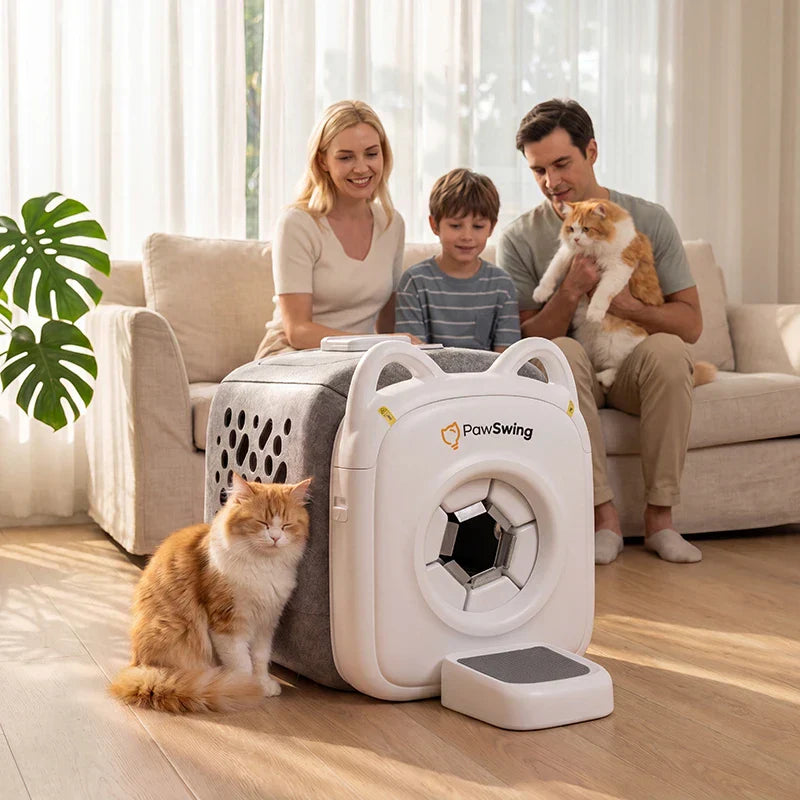
PawSwing is an innovative, automatic cat grooming chamber designed to streamline feline coat maintenance without the typical emotional toll. Traditional hand-brushing can feel restrictive and confrontational to many cats, often escalating into a battle of wills that leaves the animal hyper-vigilant and distrustful of handling. PawSwing completely flips this dynamic: when your cat voluntarily steps inside the cozy grooming house, it quietly brushes away loose fur and trapped undercoat.

How PawSwing Supports Crate Training:
  • Zero-Noise, Zero-Battery Operation: Because it operates purely via the cat's natural kinetic movement, it creates a serene environment, keeping your cat's nervous system calm and receptive to positive behavioral training.
  • Fostering Voluntary Entry Habits: PawSwing teaches cats a valuable conceptual lesson: entering an enclosed, structured space results in soothing physical comfort and stress relief. This directly mirrors the mental blueprint required for successful crate training.
  • Shedding and Odor Control: By automatically capturing shedding fur, PawSwing keeps your cat’s immediate environment pristine, reducing loose dander and airborne stress triggers near training zones.

To ensure a completely seamless introduction into your household, PawSwing offers a 60-day free trial, a 12-month comprehensive warranty, and free U.S. shipping, providing a risk-free path to elevating your cat's everyday comfort.


Common Crate Training Mistakes to Avoid

What Owners Do Wrong The Negative Consequence The Correct Behavioral Fix
Forcing or shoving the cat inside Destroys baseline trust instantly; creates a permanent trauma response to the sight of the crate. Use high-value food and patience to lure them in voluntarily.
Rushing through the steps too quickly The cat experiences sudden panic when the door locks, causing severe behavioral regression. Keep training sessions under 2 minutes and progress strictly at your cat’s individual comfort speed.
Hiding the crate away after travel The crate remains a terrifying anomaly that only appears when bad things happen. Keep the carrier permanently integrated into your home as an everyday bed or resting pod.

Frequently Asked Questions (FAQs)

How long does it realistically take to crate train a cat?

The timeline varies significantly based on temperament and history. A young kitten with no negative experiences can be trained in 3 to 7 days. Conversely, an adult cat with years of built-in vet anxiety may require 3 to 6 weeks of slow, incremental counter-conditioning.

Can an older, stubborn adult cat truly be crate trained?

Absolutely. Cats retain cognitive plasticity throughout their entire lives. The approach simply requires higher-value rewards (such as warm tuna, bonito flakes, or wet treats) and a much slower progression through the door-closing phases.

Should I keep the crate door open at home indefinitely?

Yes. Keeping the door permanently open or entirely removed during the non-training periods transforms the crate into a normal piece of the territory, effectively stripping it of its power to cause fear.

What should I do if my cat refuses treats anywhere near the carrier?

This indicates your cat’s stress threshold has been crossed. Move the treats or food bowl much further away—even to the opposite side of the room—until they eat without hesitation, then move closer by mere inches each day.

How does PawSwing complement a multi-cat crate training schedule?

In multi-cat homes, stress can be contagious. PawSwing acts as an autonomous stress-relief and grooming station that reduces daily physical friction between animals by maintaining clean, hair-free shared spaces, ensuring all household cats remain in a more relaxed, trainable state of mind.


Final Thoughts

At its core, crate training is a profound exercise in mutual trust. By shifting your approach from containment to comfort, and breaking the process down into manageable, rewarding micro-steps, you can completely dissolve transport panic. Pair your structured training with patience, meticulous cleanliness, and autonomous comfort systems like PawSwing to turn the dreaded cat carrier into a preferred sanctuary of safety and peace.

Quick Summary: Successful cat crate training hinges on transforming the carrier into a predictable, rewarding sanctuary rather than a harbinger of stress. By encouraging voluntary entry, practicing gradual door closure, and introducing motion systematically, you can ensure your cat remains calm during vet visits, travel, or necessary short-term confinement. The golden rule is simple: make the crate a normal part of your cat's daily environment long before you actually need to use it.


Why Crate Training Matters for Feline Well-Being

Most cat owners only bring out the carrier when a stressful event is imminent, such as a veterinary checkup or a long road trip. Because cats learn rapidly via negative association, the sudden appearance of the crate triggers an immediate fight-or-flight response. proactive crate training fundamentally alters this dynamic, providing massive benefits:

  • Reduced Transport Anxiety: A trained cat treats the carrier as a safe mobile bedroom, drastically lowering their cortisol levels during car rides.
  • Emergency Preparedness: In the event of a natural disaster, fire, or sudden evacuation, a cat that willingly enters their crate can save critical, life-saving minutes.
  • Frictionless Veterinary Care: Medical professionals can evaluate a calm cat much more thoroughly and safely than a panicked, defensive animal.
  • Behavioral Reset: For felines recovering from surgery or undergoing a structured behavioral reset (such as managing sudden litter box issues), a crate serves as a controlled, low-stimulus environment.

Choosing the Ideal Crate Architecture

Before beginning the training process, ensure you have the right equipment. The carrier must accommodate your cat’s specific physical and behavioral needs.

Size and Stability

The crate must be large enough for your cat to comfortably stand up, turn around completely, and lie down in a natural Sphinx or sleeping position. However, avoid excessively large crates for travel, as they lack stability and can cause the cat to slide around precariously during transport.

Accessibility and Material

Two-door carriers—specifically those featuring both a front-loading door and a top-loading hatch—are highly recommended by feline behaviorists. Top-loading options allow you to gently lower a nervous cat into the carrier or allow a vet to examine the cat while it remains safely nestled in the bottom half. If your cat is prone to stress-induced elimination or spraying, opt for a rigid, non-porous plastic crate that is entirely washable, and line it with highly absorbent, easily exchangeable training pads rather than plush, hard-to-wash beds.


The 5-Step Crate Training Roadmap

Feline behavioral modification requires a systematic approach. Progress through these steps sequentially, only moving forward when your cat remains completely relaxed at the current stage.

Step 1: Environmental Neutralization (Making the Crate Normal)

Place the crate in a high-traffic, low-stress area of your home, such as the living room or your cat’s favorite sleeping corner. Secure the door completely open so it cannot accidentally swing shut and startle them. Place a familiar, scent-soaked blanket inside. Let the crate sit as a permanent piece of household furniture for several days, allowing your cat to investigate it purely on their own terms without human intervention.

Step 2: Dietary Counter-Conditioning

Leverage the power of food to rewrite your cat's emotional response to the carrier:

  1. Day 1–3: Place your cat’s food bowl a few feet away from the open crate.
  2. Day 4–7: Move the bowl directly outside the crate's threshold.
  3. Day 8 and beyond: Move the bowl entirely inside the back of the crate.

If your cat hesitates, step out of the room to remove any perceived social pressure. Soon, they will associate the physical structure of the crate with high-value rewards.

Step 3: Implementing Vocal and Action Cues

Once your cat comfortably walks into the carrier to eat, introduce a specific verbal cue (e.g., "In" or "Crate"). Toss a high-value treat (like freeze-dried chicken or a lickable treat) into the back of the carrier, utter the cue word, and praise them warmly the moment they step inside. This transitions the behavior from a passive exploration to an intentional, active choice.

Step 4: Systematic Desensitization to Door Closure

While your cat is happily eating a treat inside the carrier, gently swing the door shut for exactly two seconds, then immediately reopen it and offer another treat. Do not latch it tightly or lock them in initially. Gradually scale up the duration of the closure:

  • Session 1: Closed for 2 seconds → Open → Reward.
  • Session 2: Closed for 10 seconds → Open → Reward.
  • Session 3: Closed for 1 minute while you sit quietly right outside the mesh.

Crucial Rule: If your cat begins to meow, scratch, or show signs of distress, you have moved too fast. Wait for a brief moment of calm, open the door, and regress to the previous step in your next training session.

Step 5: Introducing Micro-Movements

Once your cat accepts a closed door for a few minutes, close and latch the door securely. Gently lift the carrier a mere two inches off the ground using smooth, non-jerky movements. Hold it steady for a moment, place it down, open the door, and reward them. Slowly expand this into short walks across the living room, down the hallway, and eventually out to a stationary car.

Advanced Management: Cleanliness & Confinement Realities

The Impact of Olfactory Traces

Cats communicate via complex chemical signals. If an accident occurs inside the carrier due to fear-induced urination or bowel release, the crate becomes saturated with alarm pheromones. Traditional household detergents will not neutralize these scents. You must use a specialized enzymatic cleaner to completely break down the uric acid crystals. Failure to do so means your cat will smell their previous panic upon their next interaction, instantly triggering defensive behavior.

Short-Term Behavioral Confinement

In certain scenarios, a larger crate or a dedicated small room may be used for temporary confinement as part of a veterinarian-guided litter box or multi-cat reintroduction plan. This must never be used as an angry punishment for bad behavior. Instead, it serves as a secure, predictable perimeter to limit environmental choices while healthy, stress-free habits are actively rebuilt.


Synergistic Home Comfort: The PawSwing Integration

A cat’s willingness to cooperate with environmental training like crating is directly tied to their overall baseline stress levels at home. A chaotic daily routine or physically invasive handling will make them far more resistant to learning new concepts. Establishing a predictable, low-friction home-care routine is paramount—and this is where PawSwing excels.

PawSwing is an innovative, automatic cat grooming chamber designed to streamline feline coat maintenance without the typical emotional toll. Traditional hand-brushing can feel restrictive and confrontational to many cats, often escalating into a battle of wills that leaves the animal hyper-vigilant and distrustful of handling. PawSwing completely flips this dynamic: when your cat voluntarily steps inside the cozy grooming house, it quietly brushes away loose fur and trapped undercoat.

How PawSwing Supports Crate Training:
  • Zero-Noise, Zero-Battery Operation: Because it operates purely via the cat's natural kinetic movement, it creates a serene environment, keeping your cat's nervous system calm and receptive to positive behavioral training.
  • Fostering Voluntary Entry Habits: PawSwing teaches cats a valuable conceptual lesson: entering an enclosed, structured space results in soothing physical comfort and stress relief. This directly mirrors the mental blueprint required for successful crate training.
  • Shedding and Odor Control: By automatically capturing shedding fur, PawSwing keeps your cat’s immediate environment pristine, reducing loose dander and airborne stress triggers near training zones.

To ensure a completely seamless introduction into your household, PawSwing offers a 60-day free trial, a 12-month comprehensive warranty, and free U.S. shipping, providing a risk-free path to elevating your cat's everyday comfort.


Common Crate Training Mistakes to Avoid

What Owners Do Wrong The Negative Consequence The Correct Behavioral Fix
Forcing or shoving the cat inside Destroys baseline trust instantly; creates a permanent trauma response to the sight of the crate. Use high-value food and patience to lure them in voluntarily.
Rushing through the steps too quickly The cat experiences sudden panic when the door locks, causing severe behavioral regression. Keep training sessions under 2 minutes and progress strictly at your cat’s individual comfort speed.
Hiding the crate away after travel The crate remains a terrifying anomaly that only appears when bad things happen. Keep the carrier permanently integrated into your home as an everyday bed or resting pod.

Frequently Asked Questions (FAQs)

How long does it realistically take to crate train a cat?

The timeline varies significantly based on temperament and history. A young kitten with no negative experiences can be trained in 3 to 7 days. Conversely, an adult cat with years of built-in vet anxiety may require 3 to 6 weeks of slow, incremental counter-conditioning.

Can an older, stubborn adult cat truly be crate trained?

Absolutely. Cats retain cognitive plasticity throughout their entire lives. The approach simply requires higher-value rewards (such as warm tuna, bonito flakes, or wet treats) and a much slower progression through the door-closing phases.

Should I keep the crate door open at home indefinitely?

Yes. Keeping the door permanently open or entirely removed during the non-training periods transforms the crate into a normal piece of the territory, effectively stripping it of its power to cause fear.

What should I do if my cat refuses treats anywhere near the carrier?

This indicates your cat’s stress threshold has been crossed. Move the treats or food bowl much further away—even to the opposite side of the room—until they eat without hesitation, then move closer by mere inches each day.

How does PawSwing complement a multi-cat crate training schedule?

In multi-cat homes, stress can be contagious. PawSwing acts as an autonomous stress-relief and grooming station that reduces daily physical friction between animals by maintaining clean, hair-free shared spaces, ensuring all household cats remain in a more relaxed, trainable state of mind.


Final Thoughts

At its core, crate training is a profound exercise in mutual trust. By shifting your approach from containment to comfort, and breaking the process down into manageable, rewarding micro-steps, you can completely dissolve transport panic. Pair your structured training with patience, meticulous cleanliness, and autonomous comfort systems like PawSwing to turn the dreaded cat carrier into a preferred sanctuary of safety and peace.

Related Post